
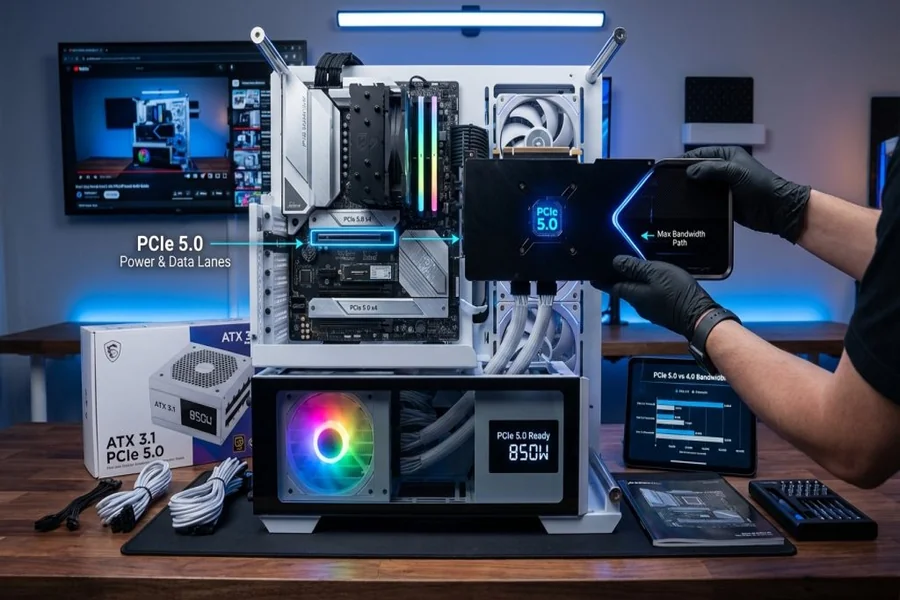
What is ATX 3.1 technology?
ATX 3.1 is an updated specification for PC power supply from the Intel company, adapted for real-life system loads, especially on the latest GPUs. It covers the rules that the power supply should follow and how to deal with sudden jumps in power draw, common for GPUs like the RTX 4090 and newer. It goes with new power cables for GPUs (12V-2×6), which have been made safer to prevent overheating or melting.
The ATX 3.1 standard is already used in the Seasonic PSU and is fully compatible with new-gen GPUs, and supports their clear and stable work. From the technical perspective, they feature updated cables and internal circuitry designed specifically for AI and high-end gaming systems.
ATX standards evolving – from ATX 3.0 to ATX 3.1
ATX standard evolving to ATX 3.1 version doesn’t mean fundamental changes from scratch. It has some updated specification parts based on new requirements from high-end systems and powerful PC components.
If compared, the ATX 3.0 standard was rolling out in 2022 and initially introduced support for sudden power spikes (transient spikes) from modern GPUs and a new 12VHPWR connector for powering GPUs. Those power supplies should be able to handle peaks up to 2000% of their rated power.
The ATX 3.1 standard (2023) keeps the rules that ATX 3.0 has but identifies and corrects its weaknesses. The core update it brings – replacing the 12VHPWR cable on 12V-2×6 one. It goes with a modified contact geometry to reduce the risk of overheating and incorrect connections. Requirements for signal stability and behavior under peak loads have also been updated. This standard is widely used today, including by Seasonic. A great example of its implementation is the PRIME PX ATX 3.1 PSU that follow new ATX 3.1 standard rules.
ATX 3.1 standard key features and improvements
The ATX 3.1 standard include teh following features and improvements:
- Updated 12V-2×6 connector (replacing 12VHPWR).
- Full compatibility with ATX 3.0, no need to upgrade the entire system.
- Refined requirements for transient spikes. This means stable operation during sudden GPU load spikes.
- Improved signal pin logic for accurate power detection by the GPU.
- Higher requirements for reliability and voltage stability.
- Updated for modern GPUs (like NVIDIA GeForce RTX 4090/5090 and newer).
Where ATX 3.1 is used: desktops and workstations
The ATX 3.1 standard is widely used in modern desktops and high-end workstations that have higher requirements for stability and system productivity. Desktop systems include powerful gaming PCs backed with NVIDIA GeForce RTX 4090/5090 GPUs. There, sudden spikes in power consumption are common, so they must be controlled and predicted. ATX 3.1 standard ensures stability during such spikes and a safe power supply operation via the new 12V-2×6 connector.
In workstations, this standard is used for supporting power-consuming AI tasks, 3D rendering, simulations and data processing, where the system operates under heavy load for extended periods. AI workstation power supply with ATX 3.1 perfectly handles these tasks.
ATX 3.1 in high-performance gaming systems
In high-performance gaming systems, the ATX 3.1 standard is used for safer power delivery from the PSU to core PC components like GPUs. In a standard work scenario, the GPU goes with short voltage spikes. So it’s highly important to have tech support and the necessary equipment that will deal with such cases. They typically show up when the game hits intense graphics or motion moments. It looks cool, but to show it to you, the GPU operates on its limits, so electricity goes much more than during a calm gaming process without bright graphics displaying. ATX 3.1 makes sure that power supplies can handle these peaks without dropping voltage.
ATX 3.1 for professional content creation and workloads
Professional content creation systems handle tasks such as 3D rendering, video editing, AI, or simulations. To handle all this stably and without freezes, GPUs and CPUs are running at full capacity for hours on end. During peak loads, GPUs consume a lot of power and create short-term load spikes. ATX 3.1 standard ensures that the power supply can handle these conditions without voltage drops or interruptions to the processes. So you don’t even mention what’s going on under the hood while you pleasantly use your PC.
The new 12V-2×6 connector also takes part in this process. It provides a reliable power supply to the GPU during long-running tasks, reducing the risk of overheating or unstable contact.
Use in data centers and enterprise server platforms
In data centers and enterprise server platforms, voltage stability is critical under peak loads, mainly when powerful GPUs are used for AI, rendering, or processing huge datasets. ATX 3.1 ensures that short-term spikes in power consumption won’t cause crashes or power drops, and the new 12V-2×6 connector provides a safe and reliable connection for high-power graphics cards.
Compatibility and implementation in modern PC components (PSUs and graphics processors)
Here’s what you need to know:
- Todays’ power supplies support the ATX 3.1 standard and the new 12V-2×6 connector for GPUs.
- The 12V-2×6 connector is compatible with the 12VHPWR one but ensures safety and guards against overheating.
- Older power supplies without ATX 3.1 support won’t provide consistent power and could hurt your components.
- Implementation of the ATX 3.1 standard includes modern circuitry, cables, and compliance with Intel’s requirements for voltage stability and component safety.
Conclusion
The ATX 3.1 standard is an updated specification that adapts to the needs of modern and high-end PC systems and their components. Supported with new sets of rules and power cables, they provide stable power delivery from your PSU to the system you use. Choose ones that support the ATX 3.1 standard to run your games and everyday tasks in one click.