
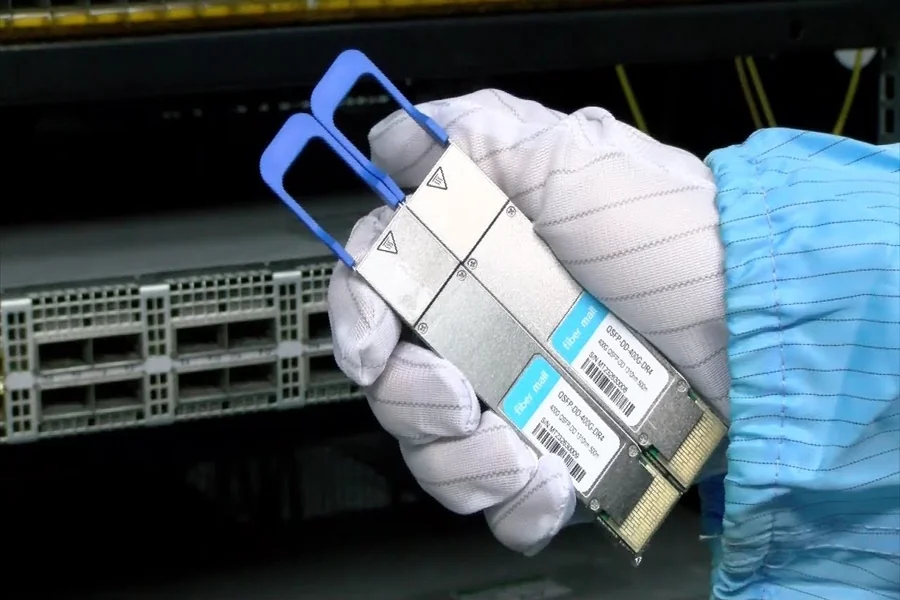
Selecting the right 400G optical module can be challenging given the variety of standards available. This guide breaks down the key 400G standards—VR4, SR4, SR8, DR4, FR4, LR4, LR8, ER4, and ZR4—and provides a clear framework to help you choose the best option for your network.
Understanding the Naming Conventions
The suffixes (VR, SR, DR, etc.) indicate the intended reach and fiber type:
- VR (Very Short Range): Up to 50 meters on multimode fiber.
- SR (Short Range): Up to 100 meters on multimode fiber.
- DR (Distance Range): Up to 500 meters on single-mode fiber.
- FR (Long Range): Up to 2 kilometers on single-mode fiber.
- LR (Long Range): Up to 10 kilometers on single-mode fiber.
- ER (Extended Range): Up to 40 kilometers on single-mode fiber.
- ZR (Zero-Dispersion Range): 80 to 120 kilometers on single-mode fiber.
These modules primarily use PAM4 (4-Level Pulse Amplitude Modulation) to achieve high data rates.
Detailed Specifications of 400G Module Standards
400GBASE-VR4
- Max Distance: 50m (OM4 MMF)
- Fiber Type: Multimode Fiber (MMF)
- Wavelength: 850 nm
- Key Specs: Uses an MPO/MTP connector and 4 parallel channels (4x100G PAM4).
- Best For: Ultra-short, high-bandwidth links within a single data center rack or aisle.
400GBASE-SR4
- Max Distance: 100m (OM4 MMF)
- Fiber Type: Multimode Fiber (MMF)
- Wavelength: 850 nm
- Key Specs: Uses an MPO-12 connector and 4 parallel channels (4x100G PAM4).
- Best For: Cost-effective, short-reach connections within a data center hall.
400GBASE-SR8
- Max Distance: 100m (OM4 MMF)
- Fiber Type: Multimode Fiber (MMF)
- Wavelength: 850 nm
- Key Specs: Uses an MPO-16 connector and 8 parallel channels (8x50G PAM4).
- Best For: High-density, rack-to-rack interconnects where parallel fiber infrastructure exists.
400GBASE-DR4
- Max Distance: 500m
- Fiber Type: Single-Mode Fiber (SMF)
- Wavelength: 1310 nm
- Key Specs: Uses an MPO-12 connector and 4 parallel channels (4x100G PAM4).
- Best For: Medium-distance campus or inter-building links.
400GBASE-FR4
- Max Distance: 2 km
- Fiber Type: Single-Mode Fiber (SMF)
- Wavelength: 1270/1290/1310/1330 nm (CWDM)
- Key Specs: Uses a duplex LC connector. It multiplexes 4 wavelengths onto one fiber pair (4x100G).
- Best For: Data center interconnect (DCI) and metro network access rings up to 2 km.
400GBASE-LR4
- Max Distance: 10 km
- Fiber Type: Single-Mode Fiber (SMF)
- Wavelength: 1270/1290/1310/1330 nm (CWDM)
- Key Specs: Uses a duplex LC connector. Similar to FR4 but with higher-power optics for 10 km reach.
- Best For: Standard long-reach DCI and metro network connections.
400GBASE-LR8
- Max Distance: 10 km
- Fiber Type: Single-Mode Fiber (SMF)
- Wavelength: 8 lanes between 1273 nm and 1309 nm
- Key Specs: Uses a duplex LC connector. Employs 8 wavelengths (8x50G PAM4) for transmission.
- Best For: Long-reach applications where compatibility with specific 8-wavelength architectures is needed.
400GBASE-ER4
- Max Distance: 40 km
- Fiber Type: Single-Mode Fiber (SMF)
- Wavelength: Typically 1310 nm or 1550 nm band (WDM)
- Key Specs: Uses a duplex LC connector. Designed for extended reach with 4 wavelengths.
- Best For: Long-haul metro connections and regional network aggregation.
400GBASE-ZR4
- Max Distance: 80-120 km
- Fiber Type: Single-Mode Fiber (SMF)
- Wavelength: C-band (1528.77~1567.13 nm, DWDM)
- Key Specs: Uses a duplex LC connector. Employs coherent optics and DWDM technology (e.g., 16-QAM) for ultra-long haul.
- Best For: Cross-city data center interconnects (DCI) and long-distance telecom backbone networks.
How to Choose the Right 400G Optical Module
- Use the following table as a quick reference and apply the three-step decision framework below.
- Comparison Table
| Type | Max Distance | Fiber Type | Wavelength | Connector | Key Technology | Primary Use Case |
| VR4 | 50m | MMF | 850 nm | MPO/MTP | 4x100G PAM4 | Intra-rack links |
| SR4 | 100m | MMF | 850 nm | MPO-12 | 4x100G PAM4 | Intra-data center |
| SR8 | 100m | MMF | 850 nm | MPO-16 | 8x50G PAM4 | High-density intra-DC |
| DR4 | 500m | SMF | 1310 nm | MPO-12 | 4x100G PAM4 | Campus/Inter-building |
| FR4 | 2 km | SMF | 4x CWDM | Duplex LC | 4x100G CWDM | Short-reach DCI |
| LR4 | 10 km | SMF | 4x CWDM | Duplex LC | 4x100G CWDM | Standard DCI/Metro |
| LR8 | 10 km | SMF | 8x WDM | Duplex LC | 8x50G WDM | Long-reach 8 links |
| ER4 | 40 km | SMF | WDM | Duplex LC | 4x100G WDM | Extended Metro |
| ZR4 | 120 km | SMF | C-band DWDM | Duplex LC | Coherent DWDM | Long-haul DCI/Backbone |
Selection Tips
Follow these three steps to narrow down your choice:
Determine the Required Transmission Distance:
- ≤ 100m: Choose VR4, SR4, or SR8 (Multimode).
- 500m to 2km: Choose DR4 or FR4 (Single-mode).
- Up to 10km: Choose LR4 or LR8 (Single-mode).
- 40km to 120km: Choose ER4 or ZR4 (Single-mode).
Check Your Existing Fiber Infrastructure:
- If your cabling is Multimode Fiber (OM3/OM4), your options are limited to VR4, SR4, or SR8.
- If you have Single-Mode Fiber, you can choose any standard from DR4 to ZR4. This offers more flexibility for future upgrades.
Match the Application Scenario:
- Data Center Internal Connections: SR4/SR8.
- Data Center Interconnect (DCI): DR4 (≤500m), FR4 (2km), LR4/LR8 (10km), or ZR4 (80km+).
- Telecom Metro & Long-Haul: ER4 (40km) or ZR4 (120km).
Conclusion
The optimal 400G module depends on a balance of distance, fiber type, and total cost of ownership. For short, cost-sensitive links inside a data center, SR4 is often the best choice. For connections between buildings or data centers up to 10 km, LR4 provides a robust and common solution. For the longest reaches exceeding 80 km, the advanced coherent technology of ZR4 is essential. By applying the tips above, you can effectively navigate the 400G standards and select the module that precisely fits your network’s requirements.